
Newsletters
How I Would Fix Tableau’s Product Strategy

The analytics industry has a habit of mistaking packaging for progress. New naming conventions. New product tiers. New AI branding. Same structural problems underneath. At some point, customers stop asking what’s new and start asking a much harder question: “Does this actually make my work easier?”
That question matters more than ever right now.
How I Would Fix Tableau’s Product Strategy
There’s a useful distinction between leaders who tear things down and leaders who are builders. Julius Caesar was good at the former. Augustus was far more interesting: he rebuilt. That distinction has been on my mind watching Tableau’s last two or three conference cycles.
Because what we keep seeing isn’t building. It’s repackaging.
Tableau still has one of the strongest installed bases in analytics. Tens of thousands of organizations rely on it every day. Entire reporting ecosystems run through Tableau dashboards, extracts, governance layers, and embedded workflows.
And yet year after year, we get another wave of renamed capabilities, repositioned features, and promises about AI-driven transformation. Most of it feels like a sticker that says “new” on something that hasn’t fundamentally changed.
The bigger issue is strategic. Tableau keeps trying to pull customers deeper into the Salesforce ecosystem instead of meeting them where they already are. That’s the mistake.
Here’s a question I’d love to see answered: what’s the actual overlap between Salesforce customers who use Tableau and Tableau customers who use Salesforce? My read, and I’d bet on this, is that Venn diagram is smaller than anyone at Salesforce wants to admit. They have a massive installed base of customers who are not Salesforce customers and likely never will be. And the strategy keeps pulling toward a center that most of their users don’t occupy.
Tableau’s Real Advantage Was Never the Walled Garden
The original magic of Tableau was accessibility. You connected data, dragged fields onto a canvas, explored, and discovered things. It reduced friction between questions and answers.
That mattered because most analytics platforms at the time felt like enterprise software designed by people who hated human beings. Tableau felt different.
Now the company is increasingly focused on tightening integration with Salesforce Data Cloud and reinforcing the surrounding ecosystem. The assumption seems to be that customers want a fully enclosed analytics environment.
Most don’t.
The average enterprise stack today looks less like a cathedral and more like a garage workbench. A little Snowflake here. Some PostgreSQL there. Excel exports. APIs. Python scripts. Claude-generated prototypes. Random internal tools held together with duct tape and good intentions.
That is the modern analytics reality.
Trying to force all of that into a single controlled ecosystem is like trying to establish hiking trails through a city that’s already grown organically. People will simply walk where they are comfortable walking.
AI Changed the Workflow Faster Than Tableau Changed the Product
This is the part I think Tableau leadership underestimates.
AI dramatically accelerated prototyping. Today, an analyst can sit down with Claude, pull data fromPostgreSQL, or whatever Excel export escaped through a system that doesn’t have an API, and build a working HTML or JSX visualization in minutes. But the workflow breaks immediately after that.
The prototype lives locally. It might get pushed to GitHub Pages, where there’s some version of control, but little governance. Not trust. Not the kind of thing your executive is going to open, let alone rely on.
We’re back to the days of emailing Excel files around. The form changed; the problem didn’t. That creates a massive opportunity. Not for tighter walls, but for better bridges.
What Tableau Should Actually Build
If I were running Tableau product strategy, I would focus on two things.
1. Reduce Friction for the Existing User Base
This sounds obvious. Somehow it isn’t.
People still struggle with layout containers. Dashboard composition is still more painful than it should be. Basic workflow ergonomics remain frustrating.
Seven years after the Salesforce acquisition. Seven years! And I’m still dealing with layout containers.
The people actually building dashboards every day keep asking for the same things: easier construction, better layout control, faster authoring, better AI-assisted calculations, less friction.
Not revolutionary. Just functional.
Tableau already knows how to win this market. They proved it. “Land and expand” worked because the product created delight at the analyst level first, not at the procurement layer or the executive strategy layer.
Come on. Make that process easier. Bring back the joy!
2. Become the Governance Layer for AI-Generated Analytics
This is the bigger opportunity.
Right now, AI tools are extremely good at generating analytics artifacts but terrible at operationalizing them. That gap matters.
Here’s the workflow I’d like to see exist:
I work with my AI agent.
It pulls from Postgres, wherever.
It builds the visualization.
I get back HTML or JSX.
I hand that to Tableau.
Tableau converts that into its proprietary format and I make the final adjustments in the award-winning UI. And now, I have something governed, trusted, authoritative, and hosted on a real server, with refresh logic and permissions and lineage already built around it.
That’s it. That’s the product.
Executives do not trust a static file someone emailed them. They’re not going to open a GitHub link. But they will open a Tableau dashboard. That trusted infrastructure already exists. Use it.
Instead of fighting AI-native workflows, Tableau could become the infrastructure that stabilizes them. That is a far stronger strategic position than simply trying to force deeper Salesforce adoption.
The Market Already Moved
The uncomfortable truth is that analytics workflows are already becoming composable. People are stitching together systems because they need speed, flexibility, and interoperability.
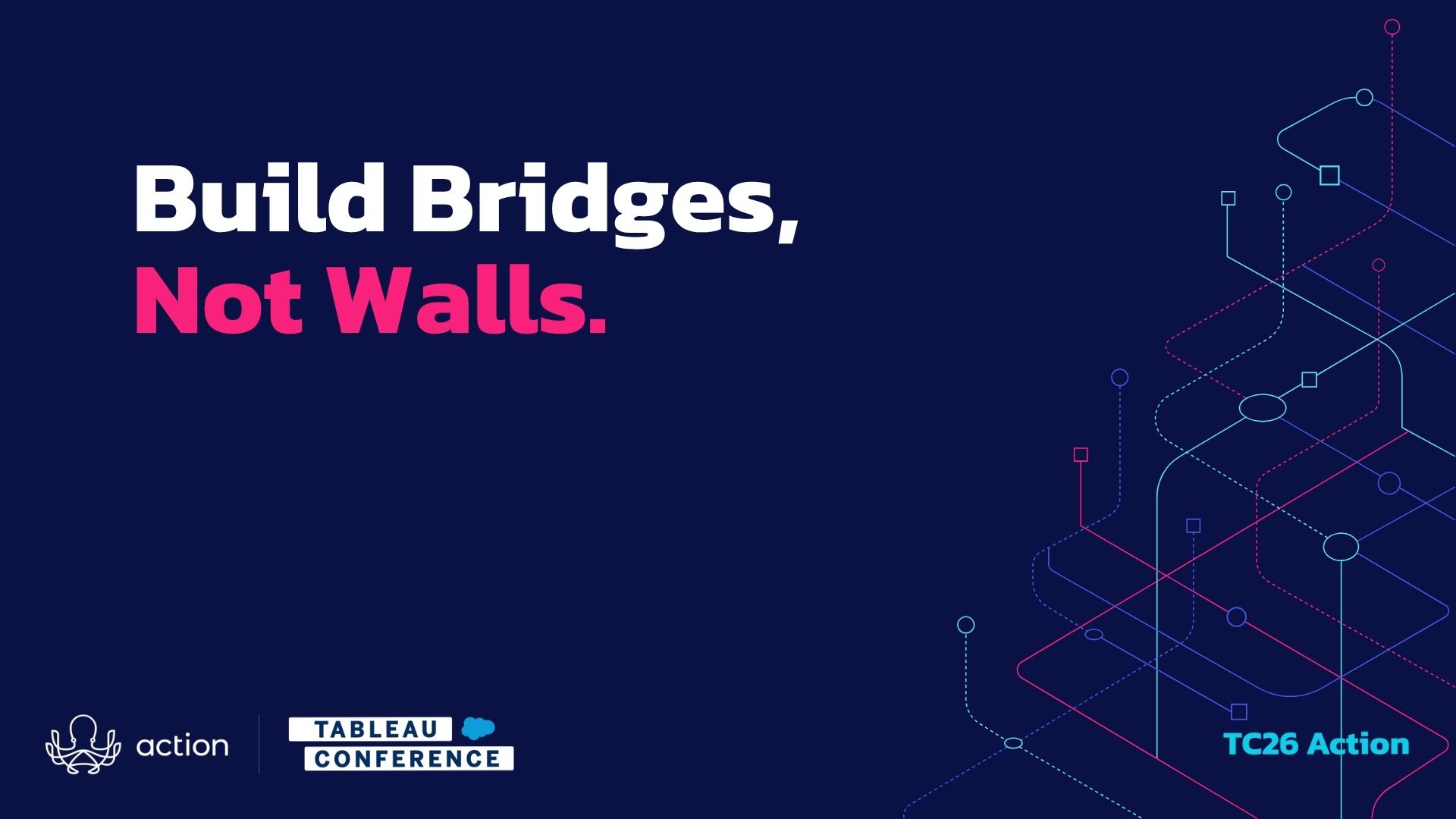
The companies that win the next decade of analytics will not be the ones with the tallest walls. They will be the ones that understand orchestration.
At Action, we talk constantly about composable systems because modern work no longer happens inside a single platform. It happens across connected systems, shared protocols, and interoperable workflows.
AI accelerated that shift. It didn’t create it.
Why This Matters
This is bigger than Tableau. Every analytics platform now faces the same existential question:
Are you trying to own the workflow or enable it?
The platforms that survive will be the ones that stop trying to own every layer of the stack. Instead, they’ll focus on becoming the trusted connective tissue between increasingly fragmented systems.That’s where the value is moving.
Not toward the wall. Toward the bridge.
So, Mr. Benioff, it’s time to tear down that wall.

Our TC26 Conference Coverage
Every year, the annual Tableau Conference gives us an opportunity to reflect on the year’s industry advances and challenges, where Tableau fits into the analytics ecosystem, and where we as a company sit within the greater scheme of things.
All of our 2026 conference coverage and post-event takeaways and analysis can be found on our TC26 mega-blog.
Shaun Davis, your personal data therapist, understands your unique challenges and helps you navigate through the data maze. With keen insight, he discerns the signal from the noise, tenaciously finding the right solutions to guide you through the ever-growing data landscape. Shaun has partnered for 10 years with top data teams to turn their data into profitable and efficiency hunting action. Learn more about Shaun.