
Artificial Intelligence
Ontology Keeps AI Grounded

When AI Sounds Confident but Isn’t
If you’ve spent any time around AI lately, you’ve probably noticed a word showing up increasingly often: ontology. It sounds academic. Philosophical. It may even trigger unwanted flashbacks to a college class you swore you’d never need again.
What was once a largely theoretical concept now has a very real-world application.
For years, “ontology” lived in the background of data architecture conversations, important but ignorable. Over the past year, and especially the past few months, it’s moved to the center of how serious AI systems are being built and evaluated.
Large language models are probabilistic by design. They predict what should come next based on patterns. That’s powerful. But it’s also deeply unreliable when the cost of being wrong is high.
Markets, leaders, and practitioners are beginning to react not to a single model or tool, but to the realization that fluent AI without grounding in reality is structurally unsafe.
Businesses don’t run on vibes. They run on definitions, rules, and consequences. In other words, you can’t automate what you can’t articulate. That gap is ontology.
The Core Tension: Probability vs. Determinism
LLMs operate in a world of likelihoods. Ontologies operate in a world of constraints.
The difference matters because AI is only useful when it can reliably understand and manipulate the concepts inside your business. Not the words. The meanings. The actions.
Ontology is how organizations define those meanings precisely. For successful automation, your business needs an ontology of its decisions, processes, metrics, and action levers. Ontology is the landscape that determines how work actually gets done.
This is why ontology is suddenly being treated as infrastructure. It’s the layer that turns probabilistic reasoning into bounded, accountable behavior.
Ontology is becoming the backbone of modern AI systems because it enables the things enterprises care about:
- Interpretability: What does the AI think this thing is?
- Governance: Is this action compliant with policy and regulation?
- Consistency: Do “customer,” “client,” and “account” mean the same thing everywhere?
- Automation: Can agents take action without breaking systems of record?
- Correctness: Do metrics roll up cleanly without drifting over time?
In the enterprise setting, hallucination isn’t quirky. It’s unacceptable.
What “Ontology” Means (No Philosophy Degree Required)
In philosophy, ontology asks, “What exists?” In AI and data systems, ontology answers a more practical question:
“What exists in this domain, and how does it relate to everything else?”
An ontology is a formal, machine-readable map of:
- Entities (things)
- Categories (types)
- Relationships (how things connect)
- Constraints (what’s allowed)
- Rules (what must be true)
For example:
- A Customer is a type of Person or Organization
- A Customer can have many Orders
- An Order contains Line Items
- A Line Item references a Product
- A Product belongs to a Category
That’s not documentation. That’s a semantic contract. And it’s more than an ERD.
The industry is now beginning to internalize that “emergent behavior” isn’t a strategy when your systems are expected to act, decide, and comply autonomously.
Why AI Keeps Bringing Up Ontology
LLMs are great at producing fluent text. However, they’re not designed to produce stable, auditable meaning on their own.
Ontologies provide the missing discipline required for meaning-making:
- Shared definitions
- Stable relationships
- Enforceable constraints
- A single semantic ground truth
Without this meaning, AI becomes an extremely confident autocomplete engine with a loose relationship to reality.
RAG Needs Semantic Anchors
Retrieval-Augmented Generation (RAG) sounds precise until you look more closely. Without an ontology, the system doesn’t know whether:
- “Client” equals “customer”
- “Employee” includes “contractor”
- “Task” is the same as “story,” “problem,” or “ticket”
Ontology resolves these ambiguities, making retrieval and synthesis deterministic.
This is the difference between AI that seems helpful and sounds fluent in a demo and AI that remains trustworthy under sustained, real-world use.
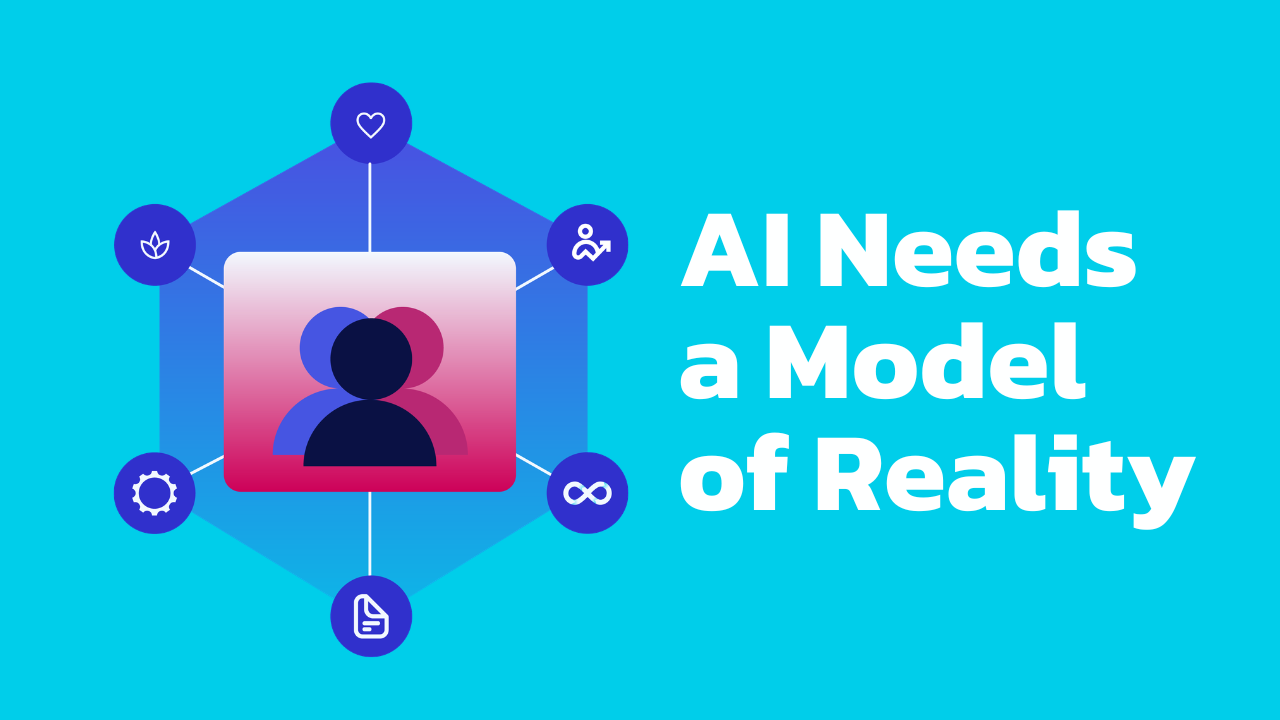
Agents Can’t Act Safely Without a Model of Reality
The moment you ask AI to do something, not just say something, things get serious. Create a record. Route a ticket. Approve a payment. Trigger a workflow.
Without an accurate ontology, systems fail quietly rather than loudly:
- Objects are created in the wrong place, with the wrong meaning
- Categories blur and drift over time
- Actions succeed syntactically but violate the business rules
- Systems of record accumulate small, compounding errors that are difficult to trace
Ontology is what turns “helpful assistant” into “trusted agentic operator.”
It also changes how the system feels to work with. Once an agent is wired into a well-defined ontology, organizational context stops being something you explain and becomes something you leverage. That shift is fast, visceral, and for many teams, genuinely surprising.
Knowledge Graphs Are Back (With Adult Supervision)
Knowledge graphs pair beautifully with LLMs. However, graphs without ontologies devolve into concept soup.
Ontology defines:
- What kinds of nodes exist
- Which relationships are valid
- What properties they can carry
Think of it as the schema that keeps your graph from melting into fiction.
This is why graph-backed AI systems suddenly feel orders of magnitude more capable once ontology is introduced: the model is no longer guessing what the world looks like. It’s reasoning inside one.
Ontology vs. Taxonomy vs. Schema (They’re Not the Same)
These terms get mixed up constantly.
- Taxonomy: Hierarchy and categorization
- Schema: Tables, columns, and data types
- Ontology: Meaning, relationships, and rules
Ontology is taxonomy plus schema plus relationship logic plus semantic discipline. It’s how systems agree on what things are, not just how they’re stored. In practice, it’s the difference between organizing information and governing reality.
The Deeper Shift: From Text Prediction to World Modeling
AI is moving away from “generate the next sentence” and toward “reason inside a model of my world.” That shift requires a world, and ontology is the formalization of that world. It’s how AI systems move from parroting fluent language to participating in decision-making without breaking everything around them.
This is the moment many organizations are coming to: the realization that the limiting factor is no longer the model. It’s the readiness and reliability of the underlying semantic structure. To be successful, a business must systematically articulate its landscape of decisions, processes, metrics, and action levers.
Where Ontology Shows Up in Real AI Stacks
You’re already seeing it, whether it’s labeled that way or not:
- Semantic layers and metrics definitions
- Knowledge graphs
- Enterprise search
- AI copilots
- Agent workflows
- Data governance programs
Every serious AI system eventually needs a shared understanding of reality. Ontology is how that understanding becomes explicit, enforceable, and scalable.
You Can’t Govern Vibes
AI isn’t primarily a compute problem, or even a language problem. It’s a meaning-management problem. Ontology is one of the cleanest tools we have for managing meaning at scale.
If AI agents without metadata are just very expensive interns, then AI systems without ontology are well-spoken and tireless, but fundamentally confused. And no amount of prompt engineering is going to fix that.
As more organizations cross the threshold from experimentation into tepid reliance, the cost of that confusion stops being theoretical, and starts to show up all at once.