

Thought Leadership
Tableau: The Business Logic Gray Box

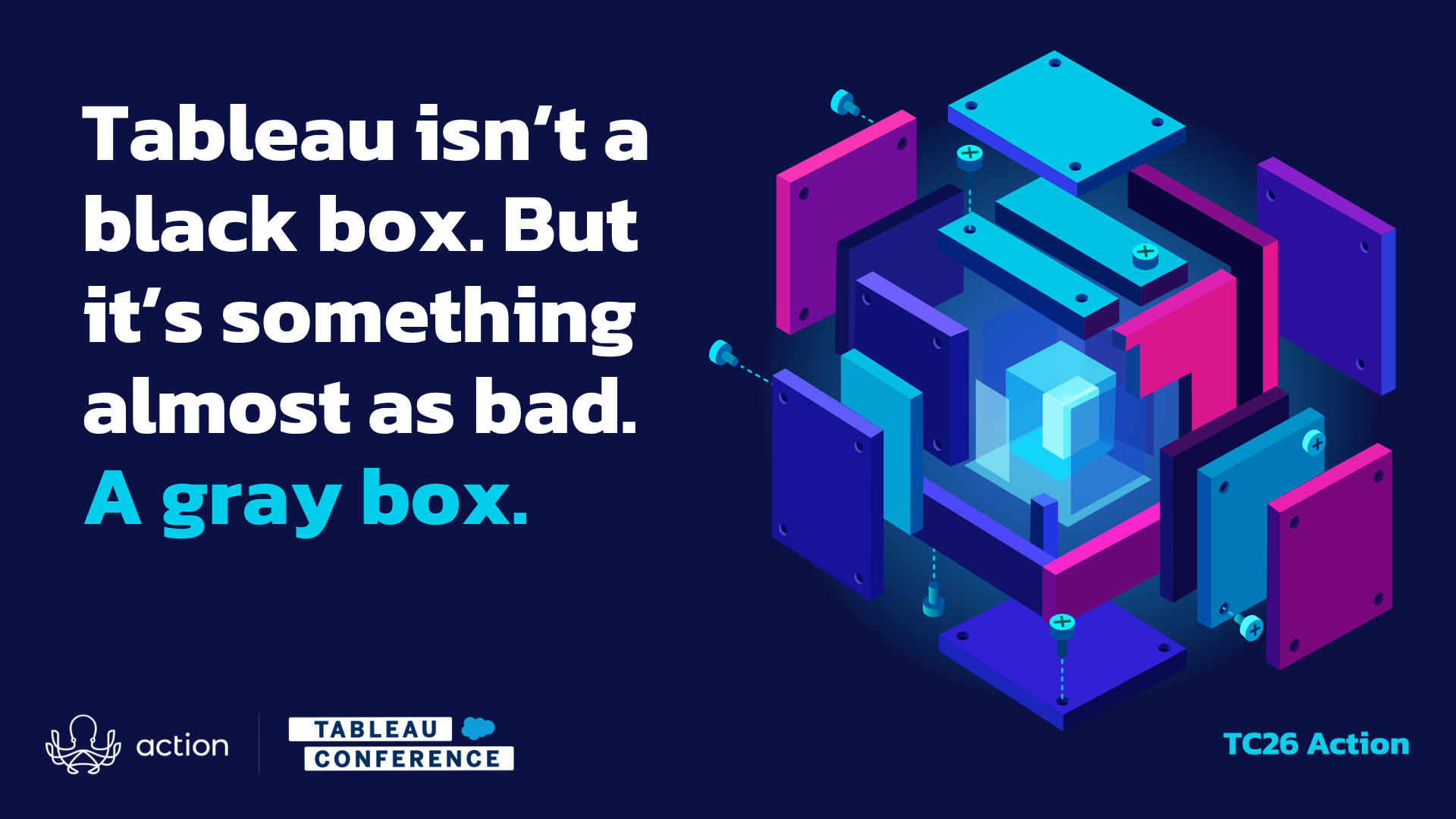
Tableau isn’t a black box.
But it’s something almost as bad.
It’s a gray box.
You can get inside it, but only if you know where to look. Most teams end up putting their business logic directly into Tableau because it’s easy:
- Calculations live in dashboards.
- Definitions get buried in fields.
- Logic gets layered over time.
Eventually, you’re left with something that technically works, but only a few people fully understand. It’s not invisible. It’s just hard enough to see that most people don’t try.
That’s the risk.
If the person who built it leaves, you’re left tracing calculations through a maze, trying to figure out what “revenue” or “active customer” actually means. And at the enterprise level, that’s not a small problem. That’s operational risk.
What we’re seeing now is a shift.
Business logic is moving out of Tableau and into code. Not because Tableau is bad at visualization. It’s great at it. But because Tableau is the wrong place to store the logic that defines your business.
When logic lives in code:
- It’s explicit.
- It’s versioned.
- It’s testable.
- And now, with AI, it’s explainable.
Anyone can step in and understand what’s happening. Tableau then does what it’s best at:
Visualizing, not defining.
If your dashboards require a specialist to interpret the logic inside them, you don’t have a dashboard problem. You have a system design problem.

Our TC26 Conference Coverage
Every year, the annual Tableau Conference gives us an opportunity to reflect on the year’s industry advances and challenges, where Tableau fits into the analytics ecosystem, and where we as a company sit within the greater scheme of things.
All of our 2026 conference coverage and post-event takeaways and analysis can be found on our TC26 mega-blog.