
Artificial Intelligence
Introducing the Query Tableau Data Agent Skill

The Action Company is excited about the release of our Query Tableau Data Skill, an open-source Agent Skill that enables AI coding agents to explore, understand, and query Tableau environments through both the VizQL Data Service (VDS) API and Tableau’s broader metadata ecosystem.
This release marks the first entry in our new Action Agent Skills series, which will be a growing collection of practical building blocks designed to help organizations move beyond AI experimentation and into governed, production-ready analytics.
The skill allows AI agents to:
- Explore Tableau’s Data Catalog for metadata
- Discover workbooks, dashboards, and views
- Understand data source lineage and structure
- Query published Tableau views
- Query Tableau data sources through VDS
- Retrieve governed data for downstream analysis
While the skill itself is useful today, it also demonstrates something larger. We believe Skills represent one of the most important emerging primitives in enterprise AI, one that will fundamentally change how organizations capture expertise and extend the value of their existing analytics investments.
In previous articles, The Rise of the Agentic Analyst and Why Skills Are the New Context Layer for Agentic Analytics, I argued that enterprise AI is shifting toward coding agents capable of solving problems by writing and executing code. This article moves from theory to practice by introducing a real implementation.
Why We Built This Skill
Coding agents are rapidly becoming the default interface for knowledge work. Unlike traditional assistants that rely almost entirely on predefined tools, coding agents interact with the world by writing software, executing terminal commands, calling APIs, and composing workflows dynamically. Rather than waiting for a human engineer to provide every capability, they routinely create their own.
That changes what organizations need to build.
Most companies spent the last decade creating software that insulated people from writing code. Today’s AI systems invert that assumption. If you want agents to work effectively inside your organization, you increasingly need products that appeal to coding agents, and therefore to the software engineers whose work those agents learned from.
For many organizations, that’s unfamiliar territory. Every company has accumulated years of institutional knowledge: undocumented processes, legacy systems, one-off integrations, and operational shortcuts known only by a handful of experienced employees. Human experts navigate these environments almost instinctively. AI agents cannot.
The solution isn’t simply better prompting, but documenting that operational knowledge in a form agents can repeatedly consume and execute.
That’s where Skills come in.
What Is a Skill?
A Skill is a reusable package of documentation, operating instructions, and supporting code that teaches an AI agent how to perform a specific task.
Rather than treating an LLM as an all-knowing black box, a Skill captures the domain knowledge, workflows, and implementation details that experienced practitioners have accumulated over years of working inside a system.
If you hired a new Tableau analyst, you wouldn’t simply hand them credentials and wish them luck.
You’d give them:
- Documentation
- A systems map
- Best practices
- Working examples
- Guidance about common pitfalls
A Skill does exactly the same thing for an AI agent.
Under the hood, Skills follow a standardized structure that modern coding agents increasingly recognize. A Skill typically lives inside its own directory, includes a SKILL.md file describing its purpose and operating instructions, and contains whatever supporting code or resources the workflow requires.
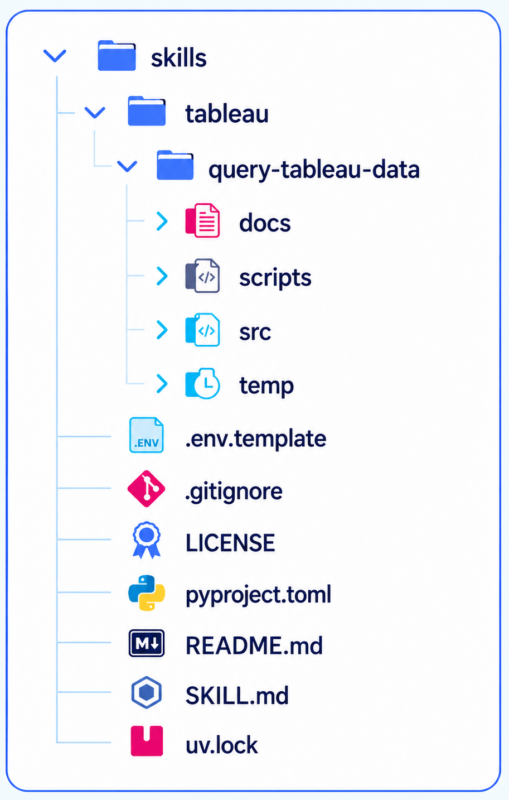
Because the structure is predictable, agents can retrieve Skills only when they’re relevant to the task at hand instead of loading enormous amounts of unrelated context into every interaction.
The result is software that behaves more predictably, operates more consistently, and becomes substantially easier to govern. Perhaps more importantly, Skills are accessible.
You don’t have to invent a new AI model to contribute meaningfully to your organization’s AI strategy. If you understand a business process well enough to document it clearly, you already possess one of the most valuable ingredients in modern agent development.
Why Tableau Requires a Different Approach
Tableau environments contain much more than rows and columns of data.
They contain:
- Workbooks
- Dashboards
- Views
- Published data sources
- Metadata
- Business logic
- Years of accumulated analytical context
A business user rarely knows which published data source contains the answer to a question. What they know is the dashboard they’ve relied on every morning for the past six months.
The visual layer inside Tableau captures decisions that extend far beyond the underlying data itself. Measures, dimensions, calculations, filters, aggregations, and dashboard design all encode business meaning that doesn’t exist if you look only at a raw data source.
Sometimes the fastest path to an answer is querying the visualization itself. Other times, it’s better to query the underlying published data source through VDS.
The Query Tableau Data Skill supports both approaches, allowing the agent to determine which path best matches the analytical task at hand.
Why Visual Analytics Matters More Than Ever
One prediction motivated much of this work. As organizations adopt agentic analytics, I believe charts and dashboards will become even more valuable, not less.
At first glance, that may seem counterintuitive. If AI agents can query raw data directly, why would they need dashboards? Because dashboards aren’t just visualizations. They’re shared analytical artifacts that capture how an organization understands its business.
A Tableau workbook encodes years of accumulated decisions:
- Which metrics matter
- Which dimensions deserve attention
- Which calculations have been validated
- Which filters reflect business reality
- Which visual relationships help people understand the data
Those decisions represent institutional knowledge. That makes dashboards one of the few places where humans and AI agents can establish an effective shared reality. More importantly, dashboards become an invaluable evaluation tool.
As organizations begin deploying analytical agents, they need reliable ways to determine whether those agents are producing correct answers. A trusted Tableau dashboard provides exactly that reference point. If an agent arrives at a materially different conclusion than a dashboard already trusted by the business, you’ve identified something worth investigating.
Human beings evaluate visual information remarkably quickly. We can often spot an incorrect chart in seconds. That makes visualizations ideal artifacts for human feedback, testing, and evaluation.
If this prediction proves correct, organizations won’t build dashboards only for people. They’ll increasingly build them for people and the agents that collaborate with them. Ironically, many of those future dashboards may be generated automatically through code.
A Different View of Agent Architecture
Much of the AI industry has spent the past year talking about protocols and connectors. Those technologies matter. Tableau’s implementation of the Model Context Protocol (MCP), for example, has made it significantly easier for agents to interact with Tableau environments. But protocols are only one layer of the stack.
Long-term advantage won’t come from exposing capabilities alone. It will come from combining three ingredients:
- Useful APIs
- Excellent documentation
- Thoughtful code abstractions
The Query Tableau Data Skill was designed around exactly those principles. It builds on Tableau’s existing APIs while documenting the workflow in enough detail for an agent to understand not only what to do, but why to do it. The Skill also includes a lightweight Python library that simplifies authentication and interaction with Tableau’s REST API while keeping external dependencies to a minimum.
The result isn’t simply another connector, but a reusable workflow. The difference here matters. A protocol exposes a capability. A Skill teaches an agent how to use that capability effectively.
A software abstraction packages both into an implementation that becomes natural for coding agents to extend. Those are three different layers of value. As agents evolve from answering isolated questions to building applications, generating workflows, and writing production software, that distinction becomes increasingly important.
No professional software engineer writes a backend service entirely from scratch. Developers rely on frameworks. Frameworks encode best practices and eliminate repetitive work.
They provide opinionated defaults that allow engineers to focus on solving new problems rather than rebuilding old solutions. Coding agents behave the same way.
If we’re designing an analytics ecosystem for AI agents, we should expect them to benefit from reusable frameworks just as human developers always have.
Building for Code-as-Action
One of the design decisions behind this Skill is embracing what many researchers now call CodeAct, sometimes described as code-as-action. Instead of forcing an AI model to reason entirely inside its context window, the agent writes small pieces of executable code that progressively explore the Tableau environment.
Our Python library is intentionally designed around a Read-Eval-Print Loop (REPL), allowing an agent with terminal access to navigate large Tableau environments efficiently.
Rather than repeatedly requesting the same metadata from an API, the agent can retrieve information once, store it as Python objects, manipulate it through ordinary code, and continue building toward a solution.
That approach plays directly to the strengths of modern coding agents. They already excel at writing software, they know how to chain operations together, and they already understand variables, loops, functions, and libraries.
Allowing them to solve analytical problems using those same tools is often far more efficient than attempting to encode every possible workflow inside prompts alone.
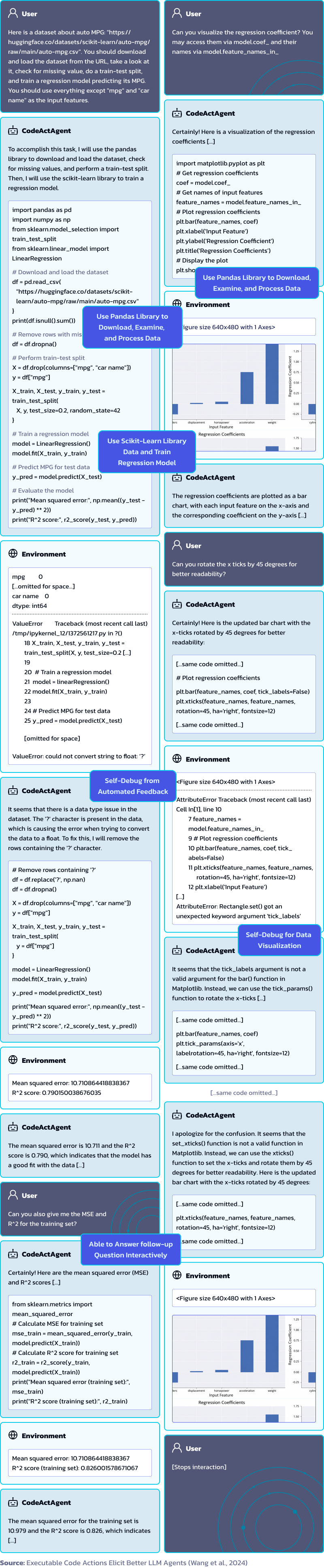
Instead of asking an LLM to remember an entire Tableau environment, we let it use code to explore that environment naturally. In many ways, we’re simply giving the agent the same development experience we would give a human engineer.
Documentation Is Becoming Product
One of the most interesting consequences of coding agents is that they blur the traditional boundary between software and documentation. For years, we’ve treated documentation as something that exists alongside software. Developers wrote code first, then documented it for the benefit of other developers.
Coding agents change that relationship.
Documentation is no longer just explanatory; it becomes operational. An agent doesn’t simply read documentation. It executes workflows based on that documentation. The quality of those instructions directly influences the quality of the agent’s behavior.
A well-documented API is no longer just easier for humans to understand. It’s easier for AI agents to use correctly, which changes the value of documentation itself.
The Query Tableau Data Skill isn’t just documentation. And it isn’t just code, either.
It’s a versioned, reusable artifact that combines instructions, implementation, and domain expertise into something agents can execute, developers can improve, and organizations can share across repositories and future Skill marketplaces.
In that sense, documentation is becoming part of the product. Not because humans suddenly enjoy reading documentation more, but because AI agents increasingly depend on it to do useful work.
Organizations that recognize this shift early will capture institutional knowledge in ways that make both their people and their agents more effective.
From Thought Leadership to Product IP
The analytics community doesn’t need another article predicting that AI agents will change everything. It needs working examples.
That’s why we’re building these Skills in the open. The Query Tableau Data Skill is both a practical tool and a demonstration of how agentic analytics can be implemented in a governed, repeatable way.
It also reflects a broader philosophy. Organizations investing in AI shouldn’t focus exclusively on connecting models to enterprise systems. They should focus on creating an exceptional Developer Experience (DX), because an excellent Developer Experience naturally becomes an excellent Agent Experience (AX).
Coding agents learn from the same abstractions, documentation, frameworks, and workflows that make human developers productive. Build software that’s pleasant and intuitive for developers, and chances are you’ve also built software that’s pleasant and intuitive for AI agents.
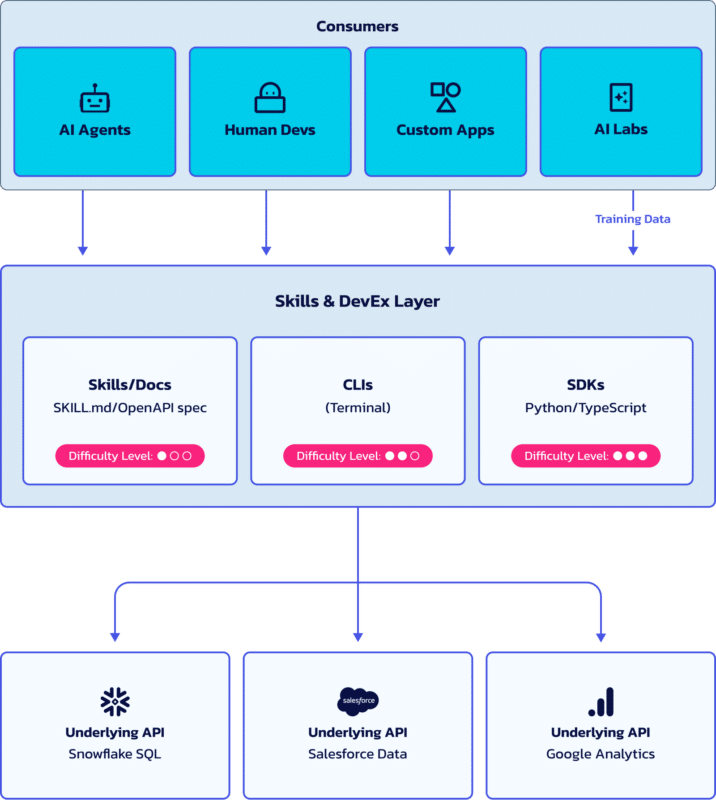
That’s a much more durable competitive advantage than simply exposing another API endpoint.
Building an Operating System for Agentic Analytics
Our goal isn’t simply to connect AI to Tableau. It’s to help organizations extend the value of the analytics investments they’ve already made while preserving the governance, business context, and shared reality that make analytics trustworthy in the first place.
The Query Tableau Data Skill is only the first entry in a larger library of Agent Skills we’re building to help organizations operationalize enterprise AI.
Each Skill captures a specific piece of domain expertise; each one makes an agent more capable. Collectively, they begin forming a reusable operating system for agentic analytics.
That’s where we believe the industry is headed. The future of analytics isn’t simply about giving agents access to data. It’s about giving them enough structure, context, and operational knowledge to use that data wisely.
Because in the age of coding agents, documentation isn’t just supporting the software anymore. Increasingly, it is part of the software.
Put Agentic Analytics Into Practice
If the future of analytics belongs to people who can effectively direct coding agents, then those agents need meaningful ways to interact with data.
That’s why we created the Query Tableau Data Skill. It helps AI agents and analysts discover, understand, and query Tableau data through the VizQL Data Service (VDS) API.
More importantly, it demonstrates a broader idea explored in this article: effective agentic systems aren’t just about models and prompts. They also need context, documentation, and well-designed skills that help agents take action.
Whether you’re experimenting with coding agents today or preparing your analytics stack for tomorrow, the Query Tableau Data Skill offers a practical example of what agentic analytics can look like in the real world.