
Agents
When AI Stops Talking and Starts Working

A Closer Look at the Systems Emerging From Ai4 2026
In Part 1 and Part 2 of my Ai4 2026 series, we looked at the larger shift happening in enterprise AI and the foundational work required to make it useful. The recurring message was that the model itself is becoming less important than everything organizations build around it: knowledge, context, governance, architecture, ownership, and trust.

So what happens when you actually build those things?
That’s where some of the most interesting sessions at Ai4 came in. Across marketing, analytics, and enterprise software, I saw early examples of systems moving beyond the familiar chatbot model. They don’t simply answer questions. They retrieve information, reason across it, assemble evidence, recommend next steps, generate interfaces, and within defined boundaries, take action.
Your Stack Needs a Nervous System
Vivek Vaidya of Kana offered one of the most useful metaphors I heard at the conference: Your MarTech stack doesn’t need another dashboard. It needs a nervous system.
Most enterprises already have plenty of tools. The problem is that those tools don’t necessarily work together as a system. Humans become the connective tissue, moving information between applications, monitoring dashboards, interpreting what changed, deciding what it means, and figuring out what to do next.
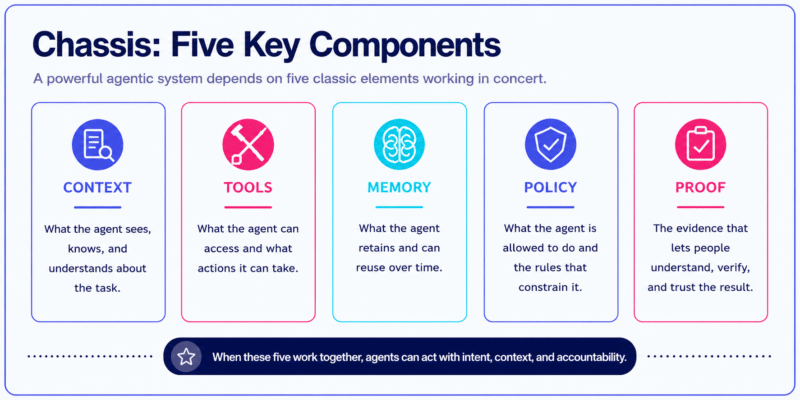
Vaidya described agentic marketing as an evolution from rules to predictive machine learning to copilots to agents. At the agent level, the system can work toward a goal, create a plan, execute it, and adapt. But doing that reliably requires what he called the agent’s chassis: context, tools, memory, policy, and proof. Enterprise-grade AI, in other words, isn’t simply a better model. It’s a better system around the model.
Enterprise-grade AI isn’t a bigger model. It’s a better chassis.
From Dashboards to Decisions
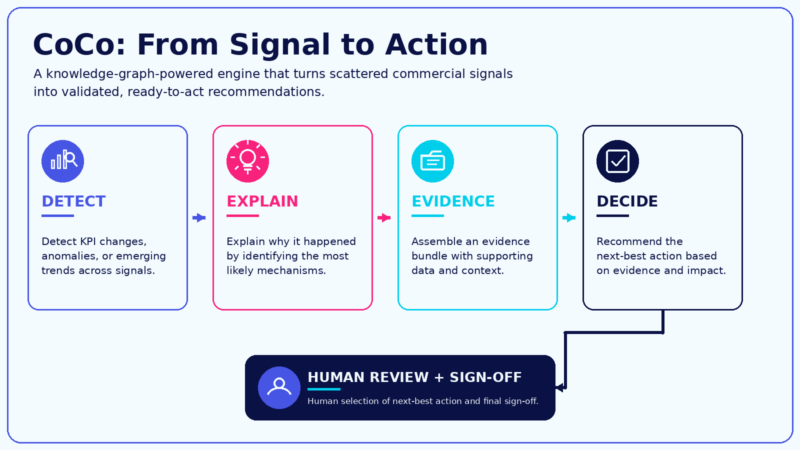
Pfizer’s CoCo showed what that kind of system can look like in practice. Shanshan Bi described a knowledge-graph-powered agentic assistant designed to connect scattered commercial signals and turn them into recommendations.
The important distinction was between a dashboard and an agent. A dashboard can tell you that a KPI changed. CoCo is designed to investigate why it changed, assemble supporting evidence, and suggest what should happen next. The workflow Bi presented was: Detect → Explain → Evidence → Decide.
Humans remain part of the process, reviewing the evidence and signing off on the recommended action. But much of the analytical work leading to that decision can happen automatically. Bi described analysis that might traditionally take weeks being compressed to roughly 30 minutes. The deliverable is no longer simply a chart. It’s an evidence-backed recommendation.
Own the Intelligence You Create
Matt Henderson of Coral raised a different question: If agents become central to how your organization works, should you own them?
His case for building important enterprise agents in-house came down to accuracy, economics, and sovereignty. Internally controlled agents can potentially access more sensitive organizational data, companies can control model and infrastructure costs, and the intelligence generated through use remains a company asset rather than accumulating inside a vendor’s platform.
That last point may be the most consequential. Agents can improve through retained memory and an increasingly sophisticated understanding of an organization’s data and workflows. If that intelligence compounds over time, ownership starts to matter.
The value that accumulates from your usage should accrue to you.
Build the Company Brain
Suku Krishnaraj of PromptQL approached the same issue from the human side. His argument was simple: Your AI is only as smart as your team.
Organizations contain enormous amounts of knowledge that never make it into formal systems. An analyst knows why a metric is calculated a particular way. Sales knows which accounts require special treatment. Someone changes a business definition. Another person discovers an exception to a rule. If none of that becomes shared context, AI continually starts from zero.
PromptQL’s approach is to capture that knowledge so it becomes reusable across the organization: Teach it once, everyone gets the skill. Instead of replacing human expertise, the system attempts to codify and compound it.
This is the “company brain” idea that surfaced repeatedly at Ai4. AI becomes much more useful when organizational knowledge stops living exclusively in individual heads, Slack threads, and scattered documents and becomes shared infrastructure.
What If the Interface Generates Itself?
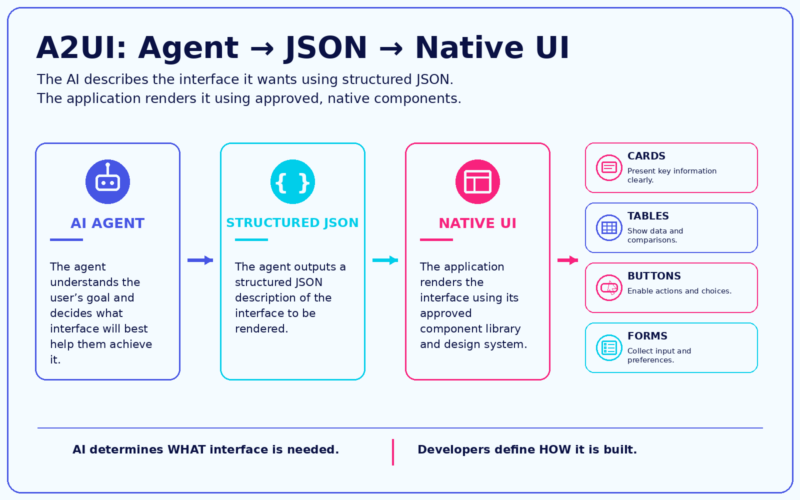
Google Cloud’s A2UI presentation offered perhaps the most visibly futuristic example. Most generative AI still uses essentially the same interface: ask a question, get a wall of text. A2UI, or Agent-to-User Interface, allows an agent to instead describe the interface needed for a particular task.
The agent sends a structured JSON description that an application can render using approved components such as cards, tables, buttons, and forms. That gives AI flexibility without simply allowing it to generate arbitrary interface code. Google emphasized three benefits: security, portability, and a more native user experience.
The larger idea is intriguing. Instead of forcing every task through a chat window or a fixed application screen, an agent could assemble the interface appropriate to what you’re trying to accomplish. The UI itself becomes dynamic.
From Agents to Agent Infrastructure
Google Cloud’s other sessions made clear that building an agent and operating agents at enterprise scale are two different problems. Terrence Ryan’s session on the Agent Development Kit focused on practical development patterns, including a recommendation to containerize agents so they can move cleanly into managed runtimes.
Ben Yevin then moved up a level to the problem of scaling and governing them. The LLM may provide the “brain,” but the agent becomes the worker or orchestrator that connects that intelligence to APIs and systems where actual work happens. Once an organization has dozens or hundreds of these workers, it needs infrastructure to build, deploy, govern, monitor, and optimize them.
That may be one of the clearest signs of where enterprise AI is heading. The interesting question is becoming less “What can this model do?” and more “How do we operate a workforce of intelligent systems safely and effectively?”
When the Pieces Come Together
What struck me about these presentations wasn’t any individual product. It was how naturally the pieces fit together.
A company brain captures shared organizational knowledge. Specialized agents draw on that knowledge and use approved tools. Context, memory, policy, and proof provide the chassis around them. Systems like CoCo turn data into evidence-backed recommendations. Generative interfaces such as A2UI dynamically present whatever humans need to understand or approve. And agent platforms provide the infrastructure to deploy and govern the whole thing.
From the sessions I attended, no one at Ai4 demonstrated that entire system. But collectively, they showed many of its parts.
For the past several years, we’ve experienced generative AI primarily as something we talk to. We ask a question, and it gives us an answer. What I saw at Ai4 suggests the next phase will be less about conversation and more about participation: AI sensing what’s happening, drawing on organizational knowledge, reasoning about it, presenting options, and acting within defined boundaries.
That’s a much bigger idea than a better chatbot. It’s AI becoming part of how the organization actually works.